Handicappers vs. MonsterGPT: Why AI Sports Analysis Beats Paying for Picks
By Monster Research
Handicapper picks lose value before you can bet them. Learn why MonsterGPT's real-time AI analysis, fair probability engine, and 30+ sportsbook comparison gives you an actual edge.
Handicappers vs. MonsterGPT: Why AI Sports Analysis Beats Paying for Picks
Every sports bettor has been there. You scroll through Twitter, see a handicapper flashing a 72% win rate, and think: maybe this is the edge I need. You subscribe, follow the picks, and three months later you're wondering why your bankroll didn't grow the way their record suggested it would.
The problem isn't always that the handicapper is lying. Some are genuinely profitable. The problem is structural — and it's why the handicapper model is fundamentally broken for subscribers.
The Odds Decay Problem
This is the single biggest reason handicapper subscribers lose money even when the handicapper wins.
A handicapper identifies Patriots +4.5 at +104 on Novig. Sharp line, clear value. They send it to their 5,000 subscribers. Within minutes, the line moves. By the time you open the alert, it's Patriots +4.5 at -110. By the time you place the bet, it's Patriots +3.5 at -110.
The handicapper's record shows a win at +104. You took the same "pick" at -110 on a worse number. That's not the same bet. The edge that made it a good play evaporated before you could act on it.
This is called odds decay — and it's unavoidable in the handicapper model. The more subscribers a handicapper has, the faster the lines move, and the less value is left for the people paying for the service.
MonsterGPT doesn't have this problem because it doesn't send you a pick. It gives you the analysis — in real time, with current odds across 30+ sportsbooks — so you can find the value yourself before anyone else moves the line.
Handicappers Specialize. Markets Don't.
Most profitable handicappers specialize in one or two markets. An NFL sides guy. An NBA totals guy. A player props specialist who only touches points and rebounds.
That's fine for them — specialization is how they stay sharp. But it leaves you, the subscriber, with massive blind spots:
- NFL handicapper? You're getting nothing during the MLB, NBA, or NHL season.
- Spreads and totals only? Player props — where the softest lines and biggest edges live — are completely ignored.
- One sport, one market? You're paying a monthly subscription for 3-4 picks per week.
MonsterGPT covers 12 sports — NFL, NBA, NHL, MLB, NCAAB, NCAAFB, WNBA, MLS, Soccer, PGA, UFC, and NCAA Baseball. It analyzes spreads, moneylines, totals, and player props across every market. Ask it about Ja'Marr Chase receiving yards, tonight's NHL totals, or a PrizePicks parlay for NBA — it handles all of it with the same data-driven approach.
One subscription. Every sport. Every market. Every night.
You're Paying for Opinions. You Should Be Paying for Data.
Here's what a typical handicapper gives you:
"I like the Chiefs -3.5 tonight. Mahomes has been cooking and the Broncos defense is banged up. Let's ride."
Here's what MonsterGPT gives you:
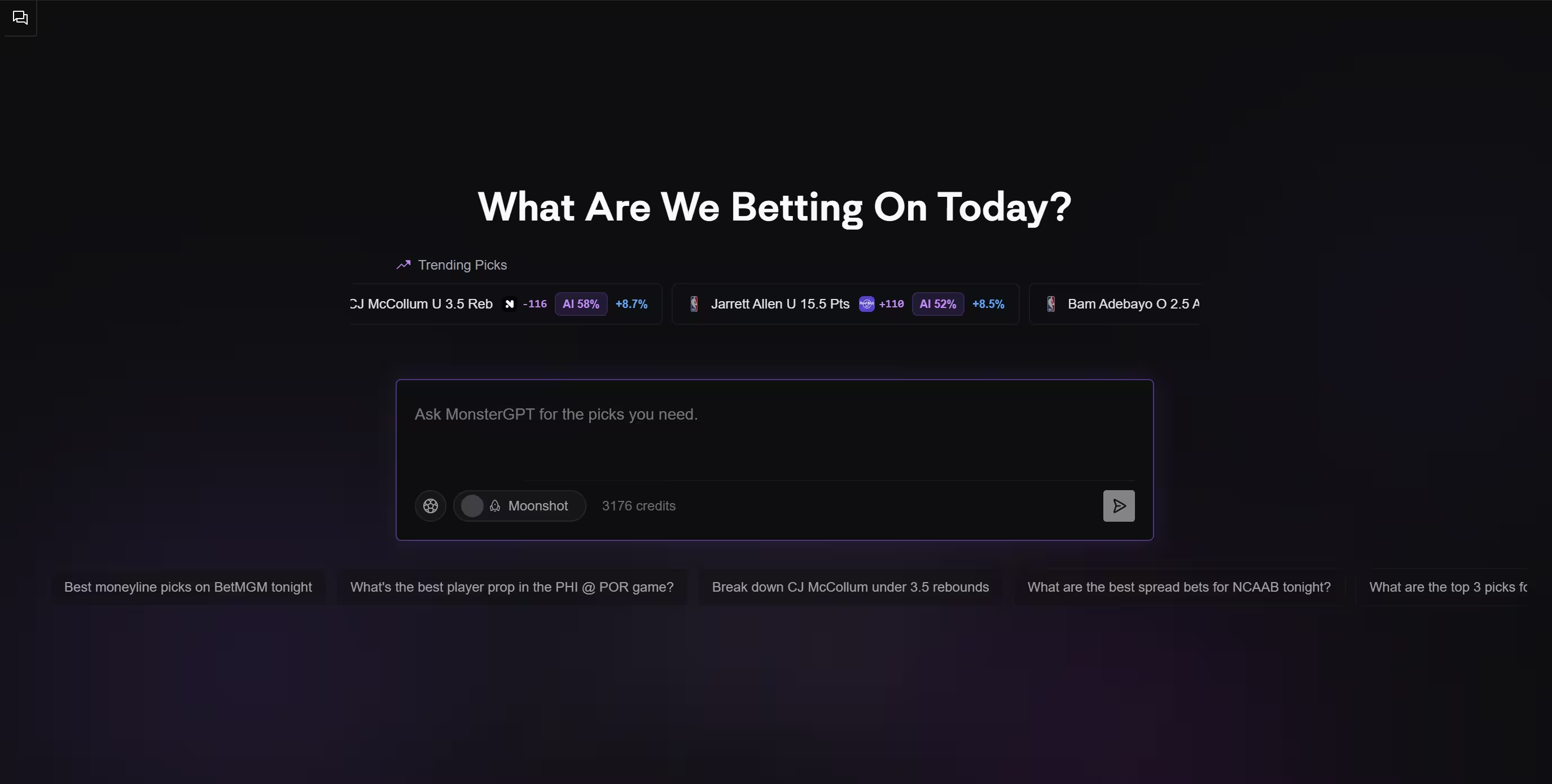
Monster Fair: Chiefs cover 54.2% | Book Implied: 51.2% | Edge: +3.0%
Analysis: Kansas City ranks #4 in EPA/play on early downs (+0.08) while Denver allows the 6th-most yards per play (5.9). The Chiefs' offensive line grades out at 78.4 in pass-blocking, giving Mahomes a clean pocket rate of 71.2% — well above his season average of 66.8% when facing Denver's depleted pass rush. Monster Fair probability of 54.2% against the book's implied 51.2% creates a 3.0% edge at the current -110 price.
The difference isn't just depth — it's verifiability. MonsterGPT shows you the exact numbers driving the recommendation. The fair probability. The implied odds. The edge percentage. The best price across every sportsbook. You can evaluate the reasoning yourself instead of blindly trusting someone's "feel" for the game.
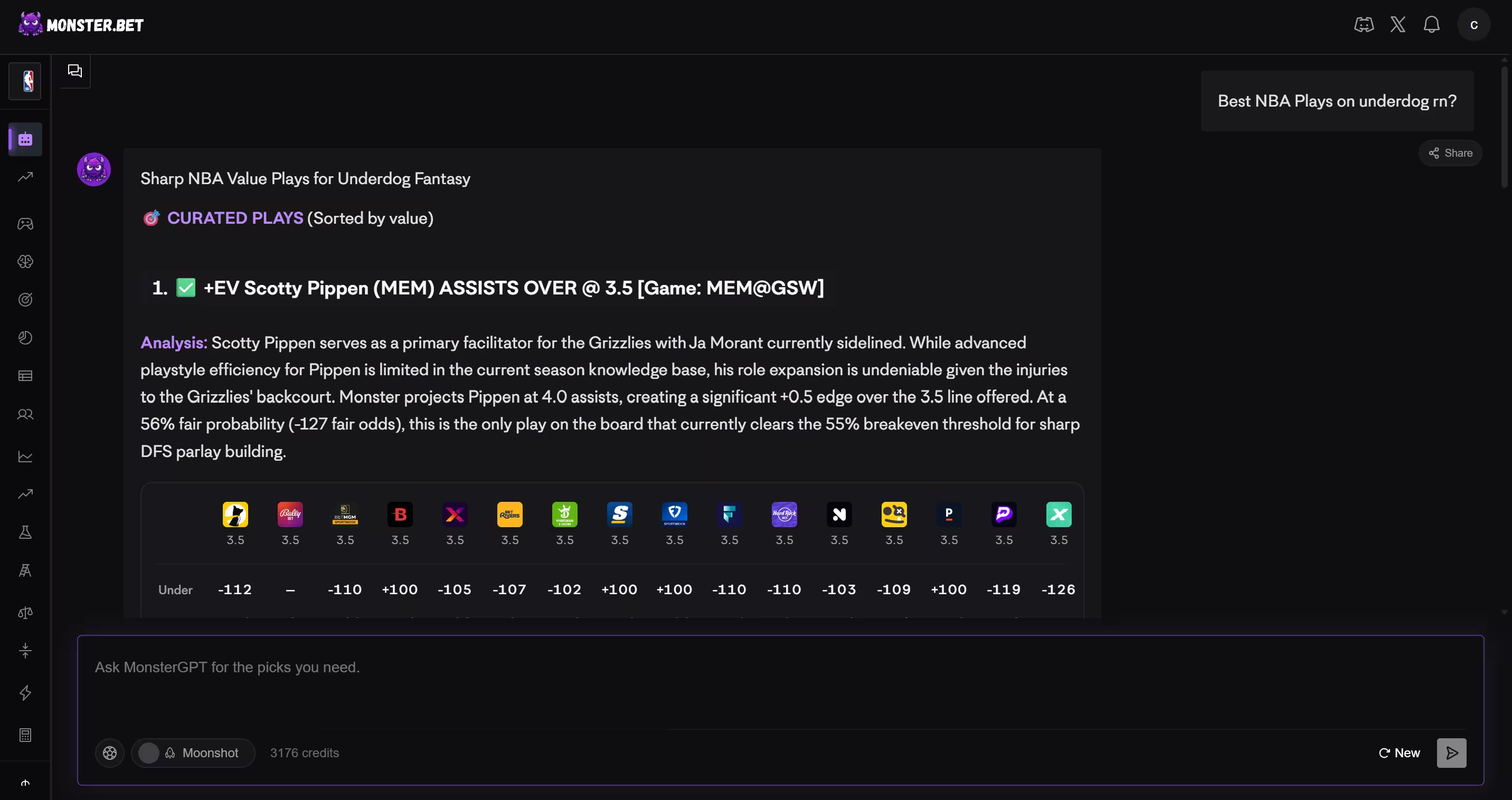
The Fair Probability Engine
This is where MonsterGPT fundamentally separates from every handicapper on the planet.
Behind every recommendation is the Monster Pricing Engine — a quantitative model that calculates fair probabilities by aggregating data from sportsbooks and prediction market exchanges. Here's how it works:
Step 1: Aggregate Odds from Every Source
MonsterGPT doesn't just check DraftKings. It pulls odds from 30+ sportsbooks including DraftKings, FanDuel, BetMGM, Caesars, BetRivers, and more. It also pulls from prediction market exchanges like Polymarket, Kalshi, and Novig — platforms where real money creates efficient price discovery.
Step 2: Strip the Vig
Every sportsbook bakes in margin (the "vig" or "juice"). MonsterGPT strips it out using advanced devigging algorithms to reveal what each book actually thinks the fair probability is — not what they're charging you.
Step 3: Weight by Market Efficiency
Not all sources are equal. A price on Polymarket backed by $500,000 in liquidity is more informative than a -110/-110 line on a small regional book. MonsterGPT weights each source by its liquidity and reliability, giving more influence to sharp exchanges and high-volume markets.
Step 4: Build Consensus
The weighted average across all sources produces a consensus fair probability — the market's best estimate of the true likelihood of an outcome. This is the number MonsterGPT compares against what your sportsbook is charging you.
Step 5: Find the Edge
If Monster Fair says an outcome has a 55% chance of hitting, and DraftKings is offering it at implied 50% (-100), that's a +5% edge. MonsterGPT finds these discrepancies across every sportsbook and surfaces the best price available.
No handicapper on earth is doing this. They're watching film, reading matchup reports, and making subjective judgments. MonsterGPT is running a quantitative pricing model that processes thousands of data points in seconds.
The EV Problem with Handicapper Picks
Expected Value (EV) is the only metric that matters in sports betting. A pick is only good if it has positive expected value at the odds you actually get.
Here's the math that handicapper subscribers ignore:
Handicapper record: 55% win rate on -110 bets. That's profitable — barely. At -110, you need 52.4% to break even. A 55% win rate yields about +4.8% ROI.
But you're not getting -110. Due to odds decay, you're averaging -115 or -120 by the time you place the bet. At -120, breakeven is 54.5%. Your handicapper's 55% edge? It just dropped to a razor-thin 0.5% ROI — and that's before accounting for the subscription fee.
The subscription fee destroys the math. If you're paying $200/month for picks and betting $100/unit on 4 picks per week, that's roughly $1,600/month in action. At 0.5% ROI after odds decay, you're making $8/month in profit before the subscription. You're paying $200 to make $8.
MonsterGPT shows you the exact edge on every bet: the fair probability, the implied odds, and the precise EV percentage. If the edge isn't there at the price you're getting, you don't take the bet. No guesswork. No hoping the handicapper's odds are still available.
Real-Time Analysis vs. Stale Picks
Handicapper picks are snapshots in time. They capture a moment when the line was at a certain number. But sports betting is a dynamic market — lines move constantly based on injury news, weather reports, sharp action, and public betting patterns.
MonsterGPT operates in real time:
- Ask a question right now and get analysis based on current odds, not odds from 6 hours ago.
- Lines moved since the morning? MonsterGPT sees the updated numbers.
- Breaking injury news? The data refreshes continuously, so the analysis reflects the current state of the market.
- Want to compare prices? MonsterGPT shows you odds across every book simultaneously, so you can grab the best number before it moves.
A handicapper sends a pick at 10 AM. By game time at 7 PM, the line has moved 2 points. MonsterGPT gives you the analysis when you're ready to bet, with the exact numbers available at that moment.
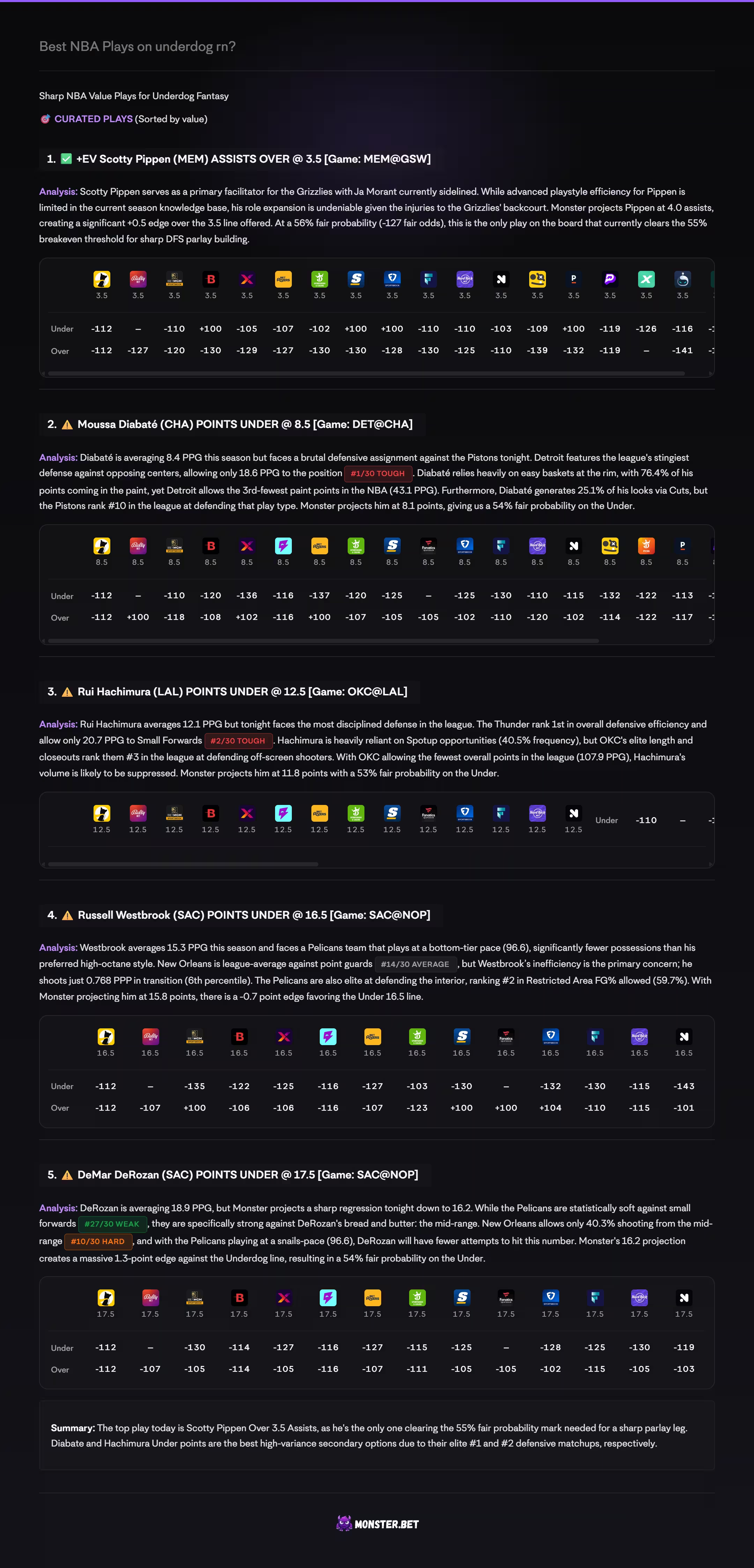
Share Your Edge
Found a great play? MonsterGPT lets you share your analysis as a shareable card — complete with the pick, the edge, the odds comparison, and the full reasoning. Show your friends the data instead of just saying "trust me."
You Don't Learn Anything from Following Picks
This might be the most underrated argument against handicapper subscriptions.
When you follow picks, you're outsourcing your decision-making. You learn nothing about why a bet has value. You can't evaluate whether the handicapper's reasoning is sound. You can't identify value on your own when the handicapper doesn't have a play.
MonsterGPT teaches you how to think about betting:
- See the edge calculation for every recommendation, so you understand what makes a bet +EV
- Compare fair probability vs. implied odds to develop intuition for line value
- Explore any market yourself — ask about a player, a game, or a prop and get the full data breakdown
- Learn which sportsbooks offer the sharpest lines and which consistently overprice certain markets
After six months with a handicapper, you're still dependent on their picks. After six months with MonsterGPT, you understand how to evaluate any betting market on your own.
The Transparency Gap
Handicapper records are notoriously unreliable:
- Cherry-picked records — showing only their best sport or market while hiding losing streaks elsewhere
- Retroactive claims — "I told my inner circle" picks that conveniently aren't in the public record
- Flat betting fiction — claiming all picks are 1 unit when they actually vary sizing, making the win-rate misleading
- No odds tracking — a "win" at -110 and a "win" at -200 are not the same thing, but both count the same in their record
MonsterGPT doesn't have a "record" because it doesn't give you a single pick to follow blindly. It gives you data, probabilities, and edges — and you can verify every number. The fair probability is calculated from publicly available odds. The edge is simple math. There's nothing to fabricate.
Coverage Comparison
| Category | Handicapper | MonsterGPT |
|---|---|---|
| Sports Covered | 1-2 | 12 |
| Markets Analyzed | Spreads/totals only | Spreads, ML, totals, 50+ player props |
| Odds Sources | 1-2 books | 30+ sportsbooks + prediction exchanges |
| Analysis Speed | Hours of film study | Seconds |
| Odds at Execution | Stale (moved by the time you bet) | Real-time, current prices |
| Edge Quantification | "I like this pick" | Exact EV%, fair prob, implied odds |
| DFS Support | Rarely | PrizePicks, Underdog, and more |
| Subscriber Impact | More subscribers = worse odds for you | No impact — you find your own lines |
| Learning Value | None — you follow, not learn | Full data transparency builds betting IQ |
What MonsterGPT Actually Does
When you ask MonsterGPT a question — whether it's "What are the best NBA bets tonight?" or "Build me a 5-leg PrizePicks slip" or "Analyze Tyrese Maxey's assist props" — here's what happens behind the scenes:
- Pulls real-time odds from 30+ sportsbooks for the relevant games and props
- Strips the vig from every line using proprietary devigging algorithms
- Aggregates fair probabilities using liquidity-weighted consensus across all sources
- Fits probability curves to derive projections for player props (what's the 50/50 point?)
- Identifies edges where sportsbook odds diverge from fair market value
- Generates analysis explaining why the edge exists, backed by stats, matchup data, and historical trends
- Shows the best price across every sportsbook so you can maximize value
All of this happens in seconds. A handicapper spending 4 hours on film study cannot match the breadth or speed of this process — and they certainly can't do it across 12 sports simultaneously.
The Bottom Line
Handicappers aren't all scammers. Some are genuinely skilled bettors. But the handicapper model is broken:
- Odds decay erases the edge before subscribers can act
- Specialization limits coverage to a fraction of available markets
- Subscription fees eat into already thin margins
- Stale picks don't reflect real-time market conditions
- No transparency in methodology or verifiable edge calculations
- No learning — you stay dependent forever
MonsterGPT replaces all of this with real-time, data-driven analysis powered by a quantitative pricing engine that aggregates odds from every major sportsbook and exchange. You get fair probabilities, edge calculations, and the best available price — for every sport, every market, every night.
Stop paying for someone else's opinions. Start making your own data-driven decisions.